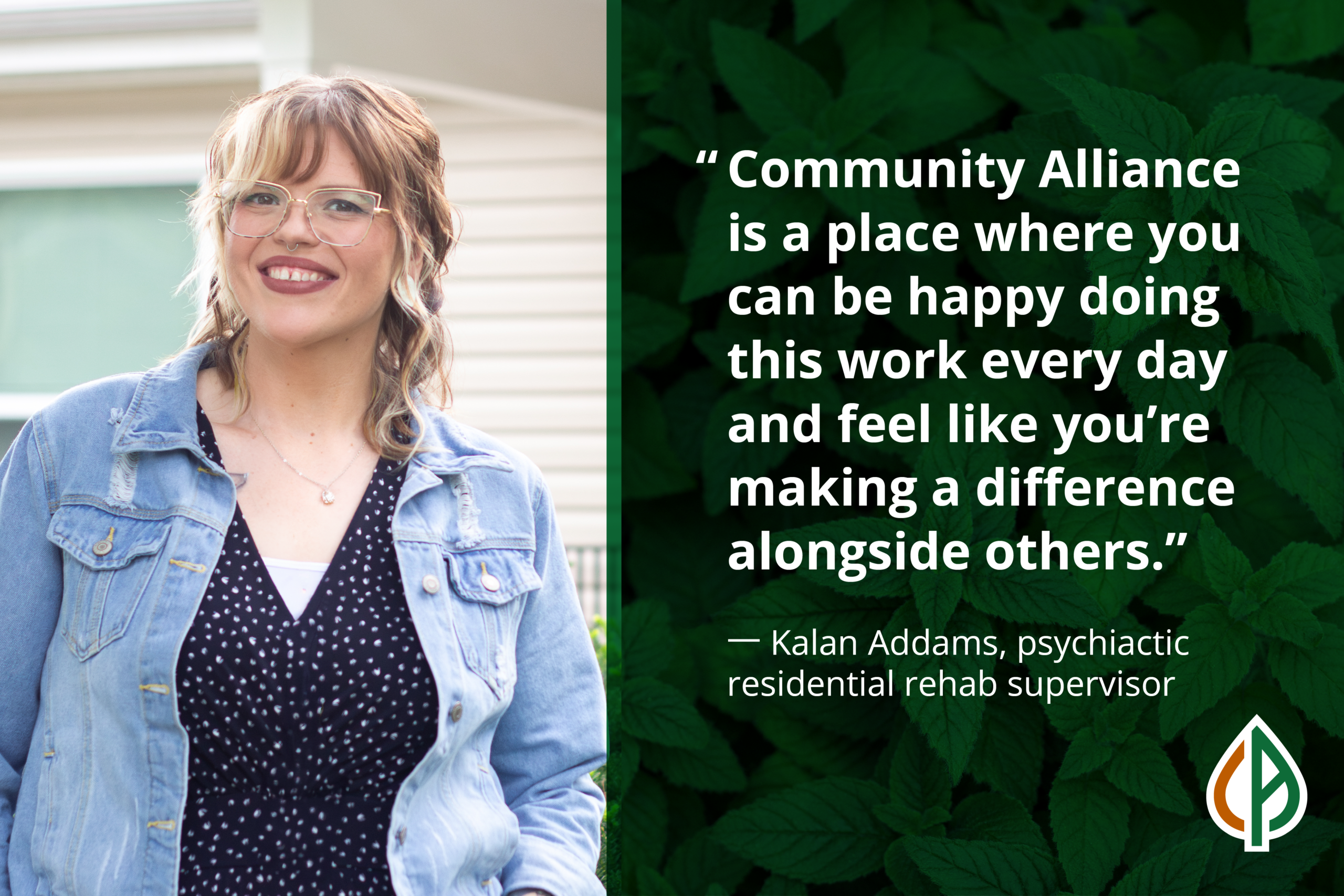
Kalan Addams’ journey with Community Alliance began as a graduate student completing her practicum and internship, where hands-on experience and the support of staff helped shape her perspective on recovery and ultimately inspired her to join the team full time. Today, as the psychiatric residential rehab supervisor, she brings that same spirit of support to the individuals she serves and the staff she leads.
Community Alliance is proud to play a role in helping the next generation of professionals learn, grow and make a difference. Our team is currently training more than 180 residents, interns, practicum students, nursing students and others this fall semester.
We spoke with Kalan about her path from graduate student to supervisor at Community Alliance, the impact of residential services and the team culture that makes Community Alliance feel like home to her.
As a graduate student, did you have an interest in working in a recovery setting before your experience at Community Alliance?
I was getting my master’s in clinical mental health counseling. I didn’t originally have an interest in working in recovery. I’ve historically worked with people with developmental disabilities and mental health challenges, which didn’t include a lot of substance use recovery.
Until my internship in Community Alliance’s Day Rehabilitation program, I didn’t have any experience with substance use. Through the support of Community Alliance staff and exposure to the individuals in that program, I realized it wasn’t as scary as I thought it might be.
I could have completed my practicum and internship at a few different places, but my program specifically wanted students to have two to three licensed instructors available instead of just one. Because of the size of Community Alliance, it could provide that additional support for master’s-level students.
I didn’t plan on staying at Community Alliance, but staff members advocated for me. It was very validating to hear that they thought I was doing a good job and was an asset. Everyone was very encouraging, and it just felt like home. It’s a place you want to be.
What misconceptions did you have before working in a recovery setting?
I had to challenge outside stigma and those biases people are just raised with, especially if you aren’t familiar with substance use disorders. There was a perpetual fear about what could go wrong or how I could truly help people. I thought my biggest struggle was going to be figuring out how to work with someone who continues to relapse.
With the support of Community Alliance staff, it was so much more manageable. They made every situation feel like one where you could partner with someone to get them where they want to be while meeting them where they’re at.
Community Alliance helped shape that perspective in me as a student. Yes, you take the classes, but having that real-life experience was key. Anytime I got frustrated or had questions, no matter who my supervisor was, they validated that it was normal. It made me feel like I wasn’t doing a bad job. Struggles are part of the work, and so is learning how to work through them. Having that team support really mattered to me.
Why did you decide to join the residential team full time?
Stacy Ring supervises the students, and she was a big piece of the puzzle for me. She interviewed me, brought me in and supervised me during that time. When it was time to potentially transition into a full-time role, she advocated for me before I even knew it. She recommended me for a job.
Her advocacy on my behalf meant a lot. When I was going through the interview process, she answered any questions I had about the job and working here. She was honest. Having someone who not only supported me as a student but also helped me take the next step in my career made a difference. She helped me make the best decision for myself professionally.
During my last few weeks of practicum, Community Alliance started training me for the full-time position. They had faith in me. While I waited to get my provisional license, they made accommodations for me. They made it a very smooth and easy transition and found a way to welcome me in immediately.
I got a lot of one-on-one guidance, and it was nice to feel that trust and support. It was an immediate click.
How does the residential program benefit individuals on their recovery journeys?
This particular setting gives individuals an opportunity to partner with staff and receive additional support. When someone is leaving a place like a hospital or incarceration, for example, their life is planned for them 24 hours a day. They’re told when they’re going to eat and what they’re going to do.
If they leave that setting and are also dealing with severe and persistent mental illness, suddenly having no structure at all can often lead to relapse and incomplete medication management. A residential program like this is a bridge to get them where they want to go.
We can assess whether people know how to cook, how to get around town to make it to medical appointments or how to access financial assistance to stay housed. If they don’t know, we teach them and get them connected to resources. They receive 24-hour support from a team member who is here to work with them on the importance of daily routines and developing habits for medication consistency so they can eventually be on their own. A lot of places don’t have that.
What does a typical day look like in your current role?
The typical part is that there is nothing typical, which is why I like it. Residential programs don’t have set business hours the way other businesses do. Every day is different.
There’s a lot of working with the residents, doing one-on-ones, managing the house and ensuring everyone has the supplies they need. It’s just being that partner.
We work on building relationships with residents every time you see them, letting them know you remember what they’re working on. I might say, “Hey, I know you had that job interview. How’d it go?” I want them to feel seen and heard, while also helping staff feel seen and heard so they can be confident in their roles.
If there’s a crisis, what someone is going through gets pushed to the front. We put them first, above meetings or plans.
What do you find most rewarding about working at Community Alliance?
When it comes to working at Community Alliance, I describe it as home. There’s a level of warmth and peacefulness, even throughout the chaotic situations we may face. Everyone is professional, we have the same goals, and we’re so aligned with the mission. I don’t have any workplace unease or conflict. I don’t see that here.
It’s so many people coming together with the same goal and each doing their part that makes Community Alliance a great place to be. If I have a problem, it’s one of the few places I’ve been where I know I can even knock on our CEO’s door.
Community Alliance is a place where you can be happy doing this work every day and feel like you’re making a difference alongside others.
When it comes to working with the individuals we serve, what’s rewarding is seeing their successes. It may not be something huge, like finishing a college program. It could be something small, like setting up transportation by themselves, getting paid employment or taking a shower that week.
Those are all successes people miss when they’re not working in a residential setting. If you have a short timeframe with someone, like one hour a week, you might not see those milestones. Here, you get to see how far they’re growing, notice those successes and celebrate them.
How would you describe the culture of Community Alliance?
Very understanding. There’s an unspoken sense of unity and teamwork. No matter who you talk to in any department, there’s this automatic sense of being a team. Everyone is there to help get individuals what they need and support each other in that process. That’s what happens when you have great people who share a common mission and truly believe in it.
There’s no sense of “we can’t.” It’s all very optimistic. There may be struggles, but that doesn’t matter. We can do this, we can help them, we can show up for them, and I can show up for you as a peer.
There are so many people who believe we can make a difference, and we’re going to make a difference together.
People will take those calls and answer those emails. They do it with such grace and openness that you never feel bad for asking questions. They believe in you as a staff member just as we believe in those we serve. We’re all learning, and we’re all growing.